Process Overview and Engineering Challenge
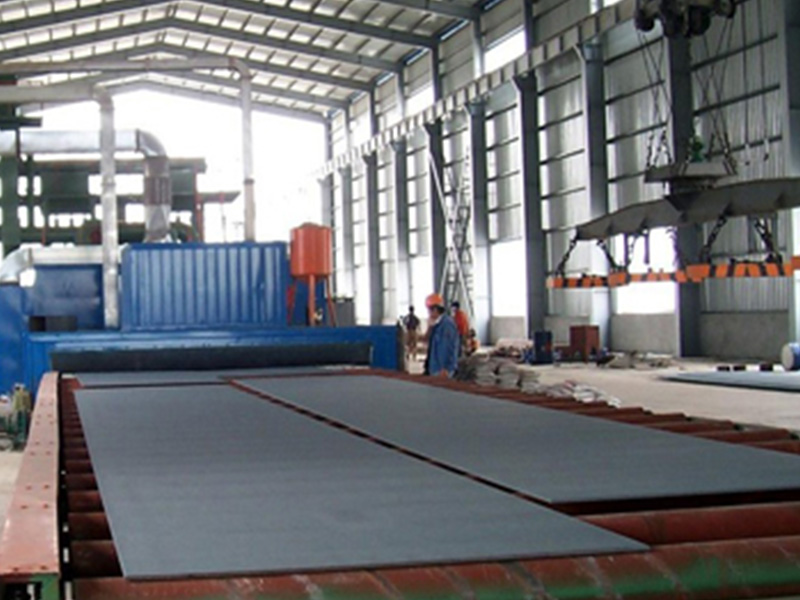
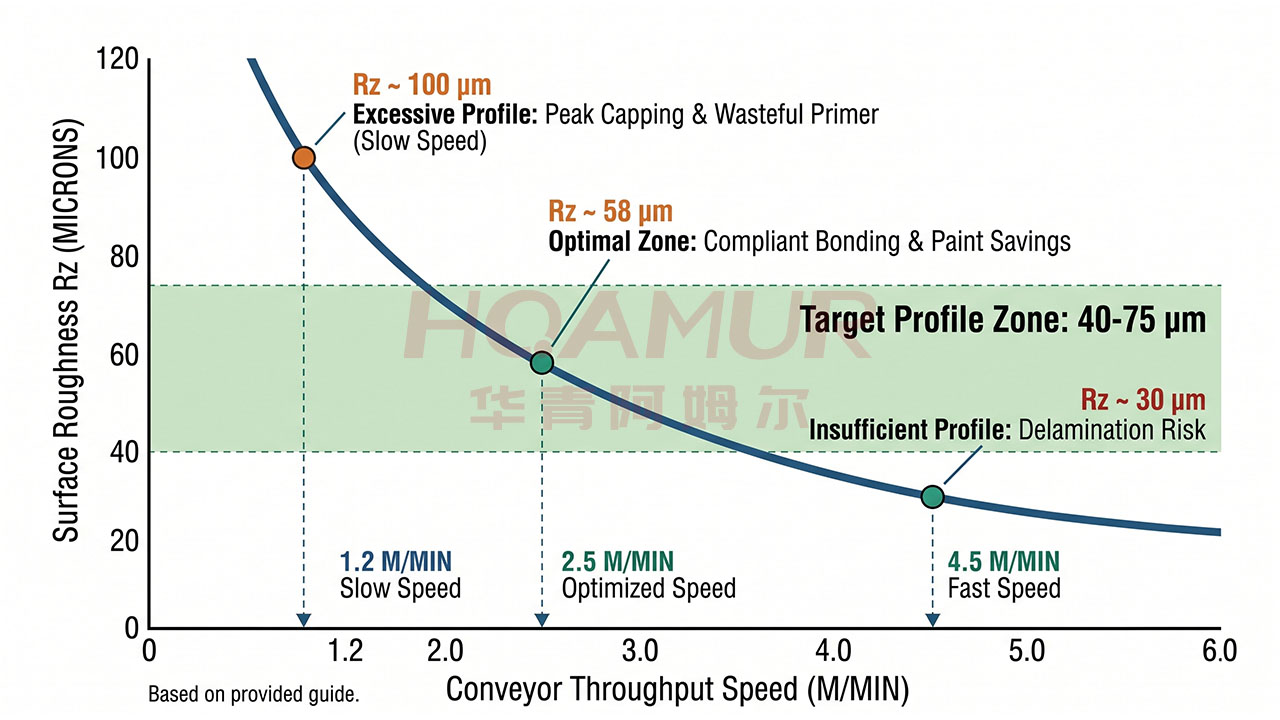
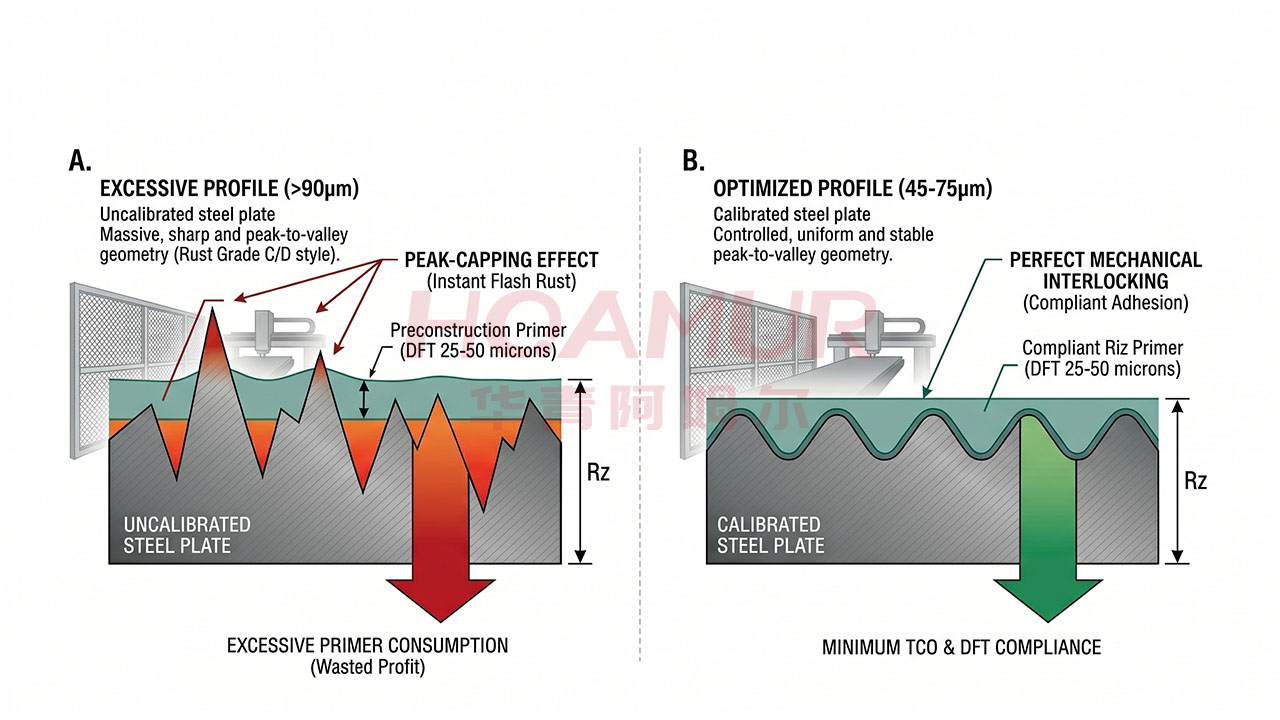
In automatic steel plate pretreatment lines, maximizing throughput speed while achieving a tightly controlled surface roughness profile (Rz) is a critical optimization matrix. For heavy industrial marine coatings and high-build primers, an insufficient Rz profile leads to catastrophic coating delamination, while an excessive Rz profile causes peak-capping, leading to premature pinpoint rusting. This guide establishes the mathematical and mechanical balance between conveyor line speeds and micro-inch anchor patterns on mild steel plates.
The Mechanics of Surface Roughness and Coating Adhesion
In heavy-duty corrosion protection, international coating specifications and AMPP/FROSIO inspectors mandate the measurement of Rz (Maximum Profile Height) under ASTM D4417 to ensure mechanical interlocking. For a standard 25 to 50 micron dry film thickness (DFT) preconstruction shop primer, the peak-to-valley profile must be maintained between 40 and 75 microns to guarantee absolute chemical bonding. If your roller conveyor line speed is uncalibrated, the abrasive impact density drops, yielding an inconsistent Rz profile across the wide steel plate surface.
High-Throughput Speed vs. Rz Anchor Profile Matrix
| Conveyor Throughput Speed | Abrasive Size Configuration | Resulting Cleanliness Level | Achieved Surface Profile Rz |
|---|---|---|---|
Fast Speed: 4.0 to 5.0 meters per minute |
100% S280 / S330 Steel Shot |
ISO 8501-1 Sa 2.0 |
Low Profile: Rz 25 to 35 microns (Unacceptable for Marine Epoxies) |
Optimized Speed: 2.0 to 3.5 meters per minute |
70% S330 Shot + 30% G40 Grit |
ISO 8501-1 Sa 2.5 |
Optimal Profile: Rz 45 to 70 microns (Perfect for High-Build Primers) |
Slow Speed: 1.0 to 1.5 meters per minute |
50% S390 Shot + 50% G40 Grit |
ISO 8501-1 Sa 3.0 |
Excessive Profile: Rz 85 to 110 microns (Risks Peak-Capping and High Paint Consumption) |
Operational Optimization Strategies
A. Blade Inverter Synchronization
To maintain a target Rz of 60 microns at higher conveyor speeds (above 3 meters per minute), increase the blast wheel linear velocity by modulating the variable frequency drive from 50Hz to 55Hz (approximately 3200 RPM). This increases the kinetic impact frequency per square meter, compensating for the faster linear movement of the steel plate.
B. Abrasive Gradation Control
Never rely on coarse abrasive to get high roughness. Coarse steel shot reduces the total pellet count per minute, creating a patchy surface finish at high speeds. Use a controlled mix of smaller S330 spherical shot to clean the tight microscopic pores and G40 angular steel grit to cut the micro-grooves required for mechanical interlocking adhesion.
Troubleshooting Checklist for Plate Pretreatment Failures
1. Hot Spot Calibration Check
If the Rz profile drops on only one side of the steel plate, the blast wheel projection angle has shifted. Re-align the control cage to ensure the concentrated abrasive stream intersects the plate at a precise perpendicular vector.
2. Working Mix Dust Saturation
Measure the percentage of micro-fines in the abrasive storage hopper weekly. If the air wash separator extraction damper is clogged, fine dust will blunt the abrasive impact, lowering Rz value while increasing electrical power consumption.