Process Overview and Engineering Challenge
In high-volume, heavy-duty surface preparation environments, selecting the appropriate abrasive floor recovery system for your sand blasting room directly dictates your plant uptime, operational cost (OPEX), and abrasive compatibility. Engineering departments face a critical choice between Mechanical Floor Recovery (utilizing heavy-duty scraper floors or motorized screw conveyors) and Pneumatic Recovery (relying on high-velocity vacuum/cyclonic suction). This guide provides a comparative engineering analysis to help facility managers choose the optimal infrastructure based on workload tonnage, grit mass density, and civil engineering limitations.
Physical Limits and Abrasive Mass Density
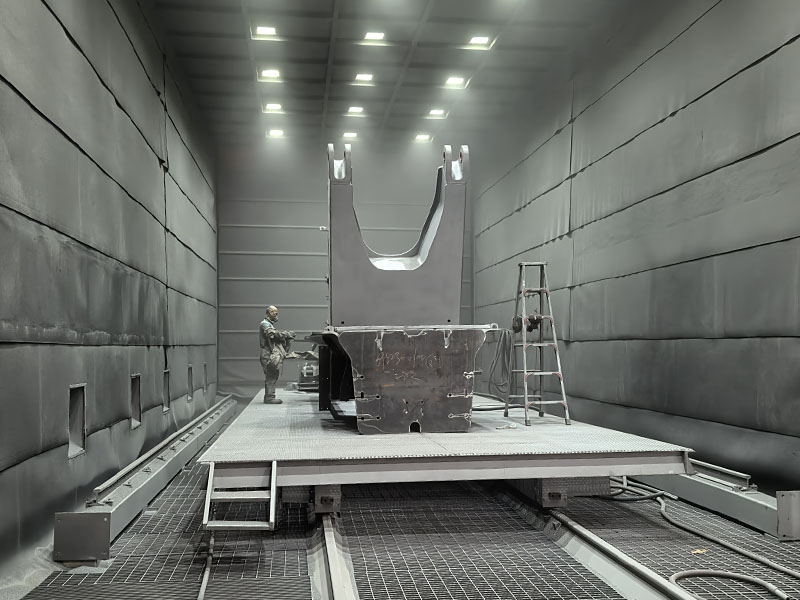
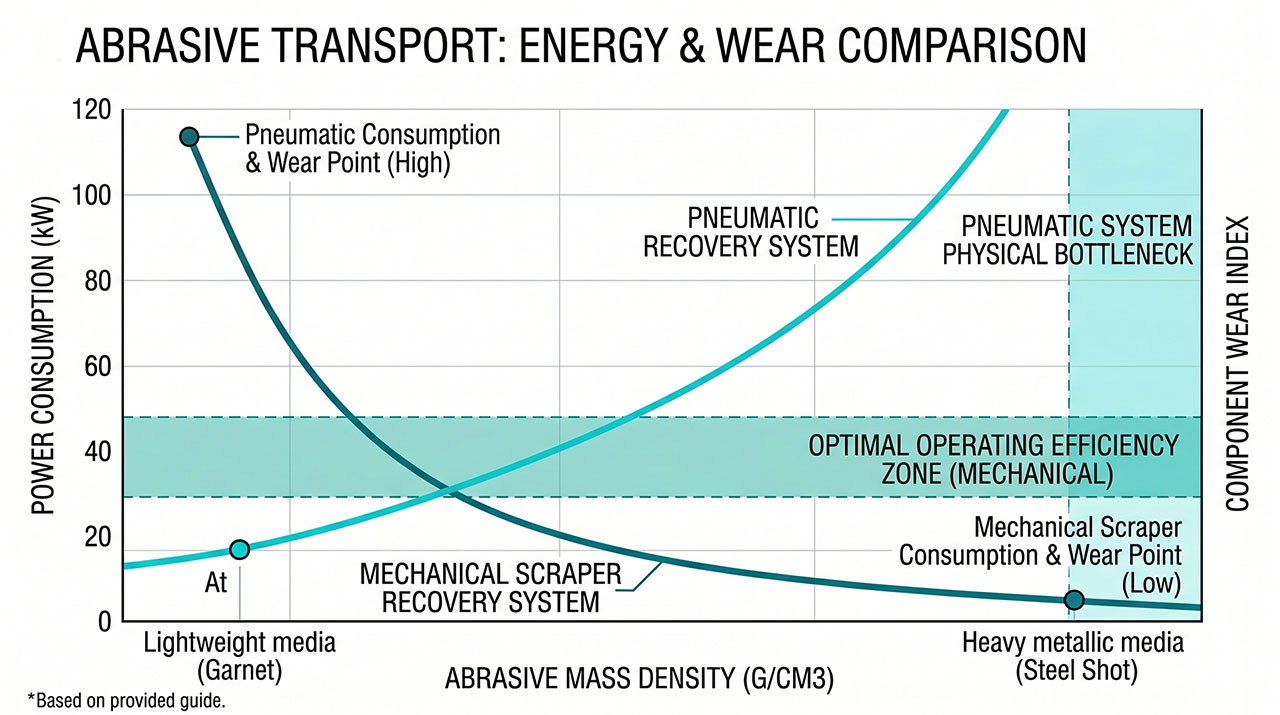
The foundational engineering matrix for recovery system selection rests entirely on the bulk density of the abrasive media. Heavy metallic abrasives, such as S330/S460 steel shot and G40 angular steel grit, exhibit an extremely high mass density (approximately 7.2 to 7.8 g/cm3). Moving tons of these high-density metallic materials via pneumatic vacuum streams requires massive kinetic energy, leading to prohibitive motor horsepower requirements and severe pipeline wear. Pneumatic recovery is thermodynamically inefficient for heavy steel grit and is technically optimized for lightweight, low-density media like aluminum oxide or garnet.
Engineering Parameter Comparison Matrix
The following benchmarking data outlines the operational differences between full-floor mechanical scraper/screw recovery systems and high-vacuum pneumatic recovery systems under identical continuous operation workloads.
| Engineering Metric | Mechanical Scraper / Screw Recovery | Pneumatic Vacuum Suction Recovery |
|---|---|---|
Abrasive Load Capacity |
Heavy-Duty: Up to 20 to 30 tons per hour continuous |
Limited: Up to 3 to 5 tons per hour max for metallic grit |
Power Consumption Profile |
Highly Efficient: 2.2kW to 5.5kW total motor drive |
High Consumption: 22kW to 45kW roots blower required |
Pipeline and Component Wear |
Low Wear: Low-speed mechanical movement, zero impact |
High Wear: Rapid abrasion at pipeline bends and cyclones |
Abrasive Media Compatibility |
100% Compatible with all heavy steel shot, steel grit, and wire cut |
Best suited for non-metallic media (Garnet, Al2O3, Glass Beads) |
Pit Excavation Depth |
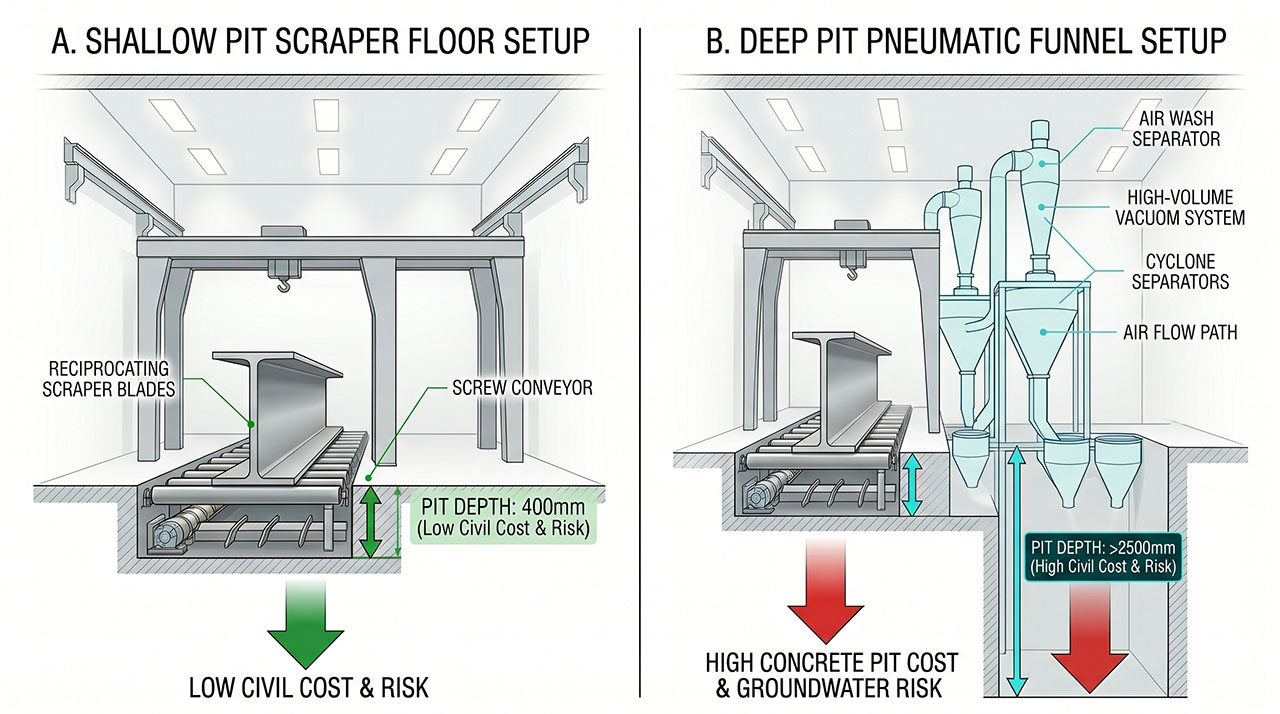
Shallow Pit Required (300mm to 500mm standard depth) |
Deep Pit or Raised Floor Required for Hopper Convergence |
Operational Optimization and Maintenance Evaluation
Mechanical Scraper and Screw Infrastructure
Mechanical floor systems employ a sequence of reciprocating rubber-edged scraper blades driven by low-speed gear motors or heavy-duty longitudinal screw conveyors. The primary advantage is low electrical power consumption combined with an incredibly high material conveying volume. Because the abrasive is moved via physical displacement rather than high-speed airflow, the mechanical wear on the floor plates is negligible. Maintenance is localized to the periodic replacement of rubber scraper flaps and terminal drive bearing lubrication.
Pneumatic Cyclonic Suction Infrastructure
Designing a pneumatic recovery infrastructure inside a standard sand blasting room requires the installation of conical hopper collection funnels under the floor grids. An active air stream fluidizes the fallen abrasive, conveying it instantly to a cyclonic air wash separator. While this eliminates all moving mechanical parts beneath the floor floor, the constant air friction of abrasive particles travelling through delivery lines at 25 to 30 m/s creates extreme abrasive wear at elbows and manifolds, necessitating heavy-gauge rubber-lined pipe replacements every few months.
Facility Checklist for Procurement Decisions
Foundation and Civil Work Limitations
If your manufacturing facility is built on high groundwater tables or leased property where deep pit excavation is forbidden, a shallow-pit mechanical scraper floor (requiring only 400mm foundation depth) is mandatory over a deep pneumatic funnel system.
Dust Control and Visibility Management
Pneumatic recovery rooms double as a passive ventilation down-draft system, which can help clear fine suspended dust faster during blasting operations. For full-floor mechanical systems, a dedicated auxiliary cartridge dust collector must be integrated to achieve independent cross-draft air changes at a rate of 0.3 to 0.5 m/s.