Process Overview and Engineering Challenge
In heavy-duty blasting infrastructure, selecting between direct-drive and belt-drive blast wheels dictates your plant’s annual utility bill and unscheduled motor rewinding downtime. Engineering procurement must look past initial asset costs (CAPEX) to calculate transmission friction slippage and spindle vibration vectors before approving technical specifications.
Kinetic Transmission Efficiency and Energy OPEX
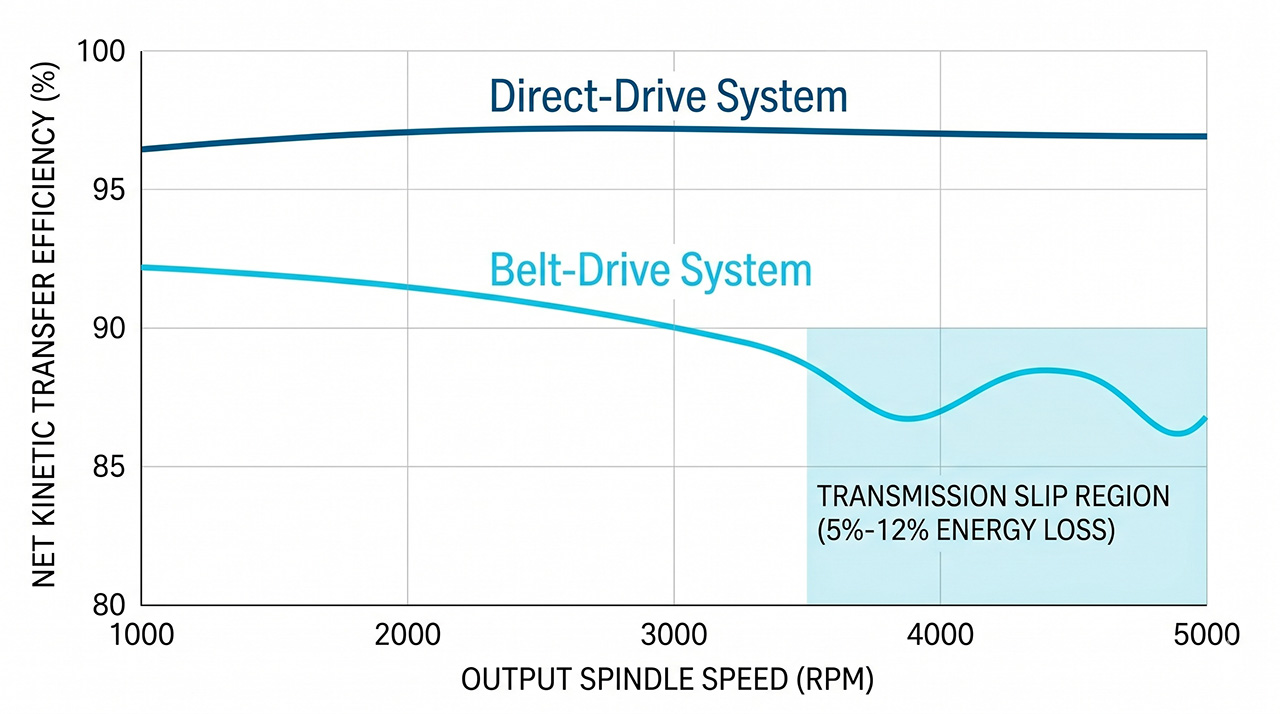
Mechanically, direct-drive configurations deliver zero transmission slip. The impeller mounts directly to the motor shaft, converting 95% to 98% of motor horsepower into abrasive throwing velocity, which minimizes electrical power loss. Belt-drive systems, however, suffer from inherent V-belt friction, pulley misalignment, and tension relaxation, causing a permanent 5% to 12% loss in rotational kinetic energy. For high-volume steel descaling plants operating multiple 37kW or 45kW wheels continuously, this mechanical slippage inflates utility bills by thousands of dollars annually.
Engineering Parameter Comparison Matrix
The following operational data contrasts the direct-drive and belt-drive wheel setups under identical 8-hour continuous shifting.
| Engineering Metric | Direct-Drive Blast Wheel | Belt-Drive Blast Wheel |
|---|---|---|
Kinetic Efficiency |
95% to 98% shaft power transfer |
85% to 92% (V-belt friction loss) |
Bearing Wear Path |
Blasting vibration vectors load front motor bearing |
Isolated: Heavy-duty pillow block bearings absorb radial load |
Max Output Velocity |
Synchronized with motor RPM (2950 RPM @ 50Hz) |
Adjustable up to 4500 RPM via pulley step-up ratios |
Routine Maintenance |
Low: Requires zero alignment or tension tracking |
High: Weekly checks for belt deflection and wear alignment |
Installation Envelope |
Ultra-compact casing fits confined blast cabinets |
External motor mounts extend the equipment footprint |
Mechanical Risk and Vibration Analysis
Motor Bearing Vulnerability in Direct-Drive Systems
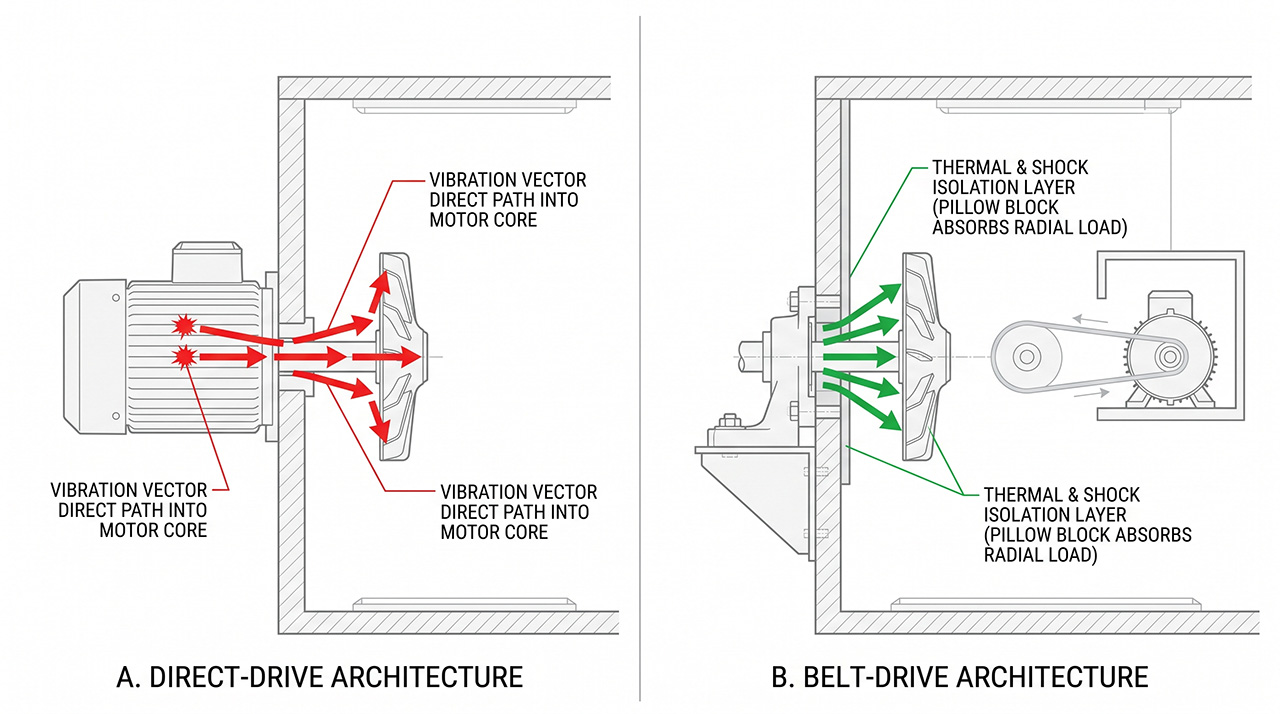
Eliminating V-belts removes a high-wear component, but forces the front motor bearing to endure the direct radial loading of the blast wheel. If an unbalanced working mix—caused by fractured steel grit or uneven blade abrasion—induces high vibration, this kinetic shock travels straight down the shaft into the motor windings. B2B buyers must specify heavy-duty motors equipped with reinforced cylindrical roller bearings and class F/H insulation to prevent premature coil burnouts.
Thermal Isolation in Belt-Drive Configurations
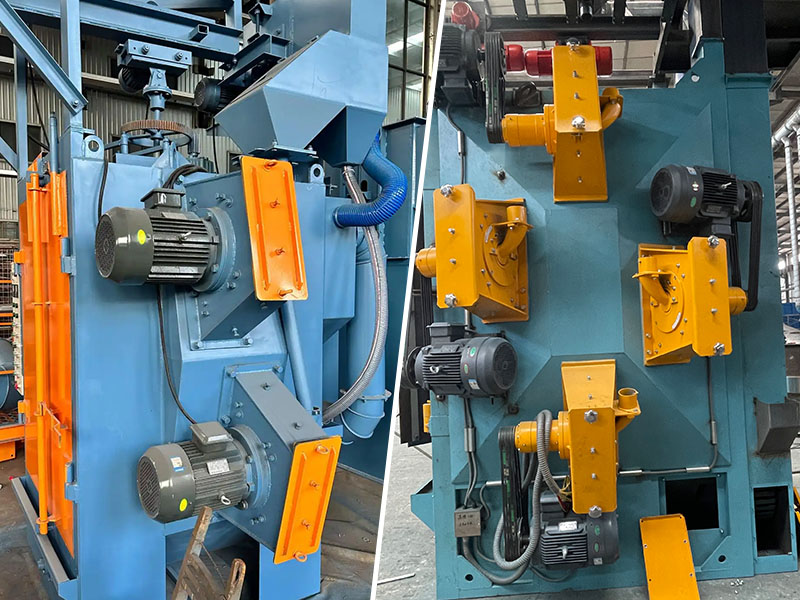
Belt-drive setups are technically mandatory for high-temperature descaling lines or sand casting foundries where parts retain residual thermal energy. The spindle pulley layout physically isolates the electric motor from the blast housing wall. High radial impact shocks and radiant ambient heat are absorbed by low-cost, replaceable pillow block spindle bearings. If a spindle seizes due to fine abrasive dust ingress, the belts slip or snap, acting as a mechanical fuse that shields the high-cost motor core from catastrophic failure.
Buyer Procurement Matrix
Plant Maintenance Crew Competency
For manufacturing facilities in remote regions lacking experienced mechanical technicians, direct-drive blast wheels minimize human error. Removing the requirement for micro-inch pulley alignment and perpetual belt tension monitoring reduces unexpected downtime caused by improper belt installation.
Digital Line Integration with VFDs
Modern automated plate pretreatment lines utilize direct-drive assemblies paired with variable frequency drives (VFD). Modulating abrasive velocity to handle distinct steel grades or mill scale profiles is fully digitized. The factory scales from a gentle surface sweep to a deep Sa 3.0 profile via software HMI calibration, rather than shutting down production to swap out mechanical pulleys.